Online Ads Are Tracking You. Some Are Trying to Hack You.
How Forbes and the NYT accidentally served ransomware to their readers, plus every method advertisers use to follow you across the web.
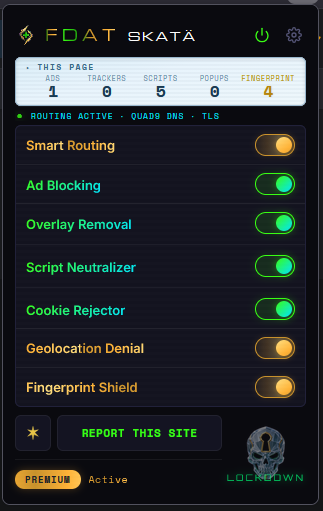
Read More →FDat! Privacy Tool blocks ads, strips trackers, rejects cookies, and intelligently routes your connection through regions with superior non-oppressive privacy policies. All without breaking your regular browsing.
Only affected sites are re-routed. Your work VPN, banking, streaming and regular browsing all stay fast and direct. No conflicts, no captchas, no slowdowns.
We maintain custom lists covering 99% of the web. These are continuously updated as the landscape changes.
UTM, fbclid, gclid, TTCLIDs are all stripped automatically. Tracker scripts replaced with harmless stubs.
Automated rejection of cookies. Recognises 50+ consent frameworks and popup patterns.
Even with a VPN, malicious websites can obtain your IP through WebRTC leakage. With our tool, you're protected.
Blind-token system. We never know who you are, and couldn't find out even if we wanted to. SHA-256 hashed tokens. No emails, no accounts.
Unlike a VPN that tunnels ALL your traffic (slowing everything down, breaking logins, constant captchas), FDat! Privacy Tool only re-routes the sites that are actually affected by geo-restrictions. Everything else takes is routed normally
Add FDat! to Chrome or Firefox. No account needed. A random token is generated locally.
FDat! loads a region-specific list of geo-blocked domains. It detects your country automatically.
Affected sites go through an encrypted tunnel. Everything else goes direct. Your ISP can't tell the difference.
Ads blocked, trackers stripped, cookies rejected, WebRTC sealed. All automatic, all the time.
No account. No email. No tracking. Install and go.
Yes, completely free. We offer an optional premium tier for faster proxy speeds if you need it, but the free tier is already pretty fast and includes all privacy features. Just click our sponsors occasionally so we can keep the servers running.
A VPN tunnels ALL your traffic through a remote server, slowing down everything
and flagging all your traffic as VPN traffic. This means constantly having to enter captchas, "are you a
bot?" checks, and logins breaking. Some regular websites simply block VPN traffic. FDat! only routes select
sites through its smart chain so your regular browsing stays at full speed. No need to switch your VPN on
and off. Think of it as a "smart VPN" that only activates when needed.
If you want full coverage for
every single website or to protect more than just your browser, that's when a VPN makes sense. For most
users that's not the case.
No! Our servers have logging completely disabled. We never see what sites you visit, and our anonymous token system means we don't even know who you are.
Currently: UK, EU, and AU. Each region has a user-generated list of geo-blocked domains. You can submit any blocked sites you discover and if the trust score is high enough, our system will include it in the next update.
Yes! Use the extension's "Submit a Site" feature. Websites that promote violence, racism or illegal content are not welcome. (e.g. foxnews.com)
If you'd like to support this project, just buy us a coffee! Every donation receives 30 days of prioritised bandwidth, increased usage allowance and zero ads. Click the upgrade link on the extension or the extension's Settings/Account page (click the cog to open settings).
We use a blind-token authentication system. Your random token is generated locally and never leaves your browser. Only its SHA-256 hash is sent to our server. We can't reverse the hash, so we can't link your identity to your usage.
Android: Yes! Firefox for Android supports extensions, so you
can install FDat! from the Firefox Add-ons store. Some Chromium-based browsers like Kiwi Browser also
support Chrome extensions on Android.
iOS: Not yet. Apple doesn't allow browser
extensions
in Chrome or Firefox on iPhone/iPad. Safari extensions require a companion app, which we're exploring for a
future release.
How Forbes and the NYT accidentally served ransomware to their readers, plus every method advertisers use to follow you across the web.
Read More →Both countries now require real ID to view adult content online. Here's what the laws say, what sites are blocked, and the privacy risks nobody's talking about.
Read More →Ofcom's new enforcement powers target end-to-end encryption and age verification. We break down what the Online Safety Act means for your digital rights.
Read More →We reviewed 4 major VPNs based on real audit results, jurisdiction, and real-world proof. Plus: when a VPN isn't the right tool for the job.
Read More →The DSA requires platforms to remove "illegal content" within hours. But who decides what's illegal? And why are legitimate sites getting caught in the crossfire?
Read More →The Online Safety Amendment Act 2025 expanded ACMA's powers to block websites without court orders. Here's how it affects your browsing and what you can do about it.
Read More →
Found a bug? Want a feature? Just want to say hi?
We love hearing from our users.